
Every cell in your body is running a continuous energy budget, and oxygen is the currency. Your red blood cells carry it, your mitochondria burn it, and the moment supply dips below demand — from injury, inflammation, poor circulation, or simply aging — repair slows down. Oxygen therapy exists to flip that equation. Instead of waiting for damaged tissue to pull in oxygen through compromised blood vessels, we flood the body with so much oxygen that it dissolves directly into the plasma and reaches places red blood cells physically cannot.
As the clinician who runs our hyperbaric program, I spend a lot of my day explaining what actually happens inside the chamber. This is the long version — the one I wish every patient read before their first session.
What "Oxygen Therapy" Actually Means
Oxygen therapy is a broad term. A nasal cannula at a hospital is oxygen therapy. So is a 20-minute "oxygen bar." But when we talk about oxygen therapy at Zen, we mean Hyperbaric Oxygen Therapy (HBOT): breathing concentrated oxygen inside a chamber pressurized above normal atmospheric pressure. The pressure is the whole point. At sea level, your hemoglobin is already about 97% saturated — breathing extra oxygen barely moves the needle. Under pressure, oxygen dissolves into the liquid portion of your blood, your lymph, and your cerebrospinal fluid in quantities that are physically impossible at normal pressure.
That dissolved oxygen is what reaches swollen tissue, bruised joints, post-surgical sites, and areas of the brain with sluggish blood flow. It is the difference between topping off a tank and pressure-washing the whole system.
The Physiology: Henry's Law in a Comfortable Chair
The science comes down to a 200-year-old gas law. Henry's Law states that the amount of gas that dissolves into a liquid is proportional to the pressure of that gas above the liquid. Double the pressure, roughly double the dissolved gas. In a chamber at 1.5–2.0 ATA (atmospheres absolute), plasma oxygen content can rise 10 to 15 times above baseline.
- Hyperoxygenation — oxygen reaches tissue that damaged or constricted capillaries cannot supply
- Angiogenesis — repeated sessions signal the body to grow new capillaries into oxygen-starved areas
- Stem cell mobilization — studies show a 2–8x increase in circulating stem cells after a series of treatments
- Anti-inflammatory signaling — down-regulation of inflammatory cytokines and reduced tissue edema
- Antimicrobial effect — high oxygen tension impairs anaerobic bacteria and boosts white blood cell function
- Mitochondrial support — more substrate for ATP production, which patients feel as steadier energy
Who We See Benefit Most
Post-Surgical and Post-Procedure Recovery
This is our largest group. Hair transplant patients, cosmetic surgery patients, and orthopedic patients come in because swelling, bruising, and incision healing are oxygen-dependent processes. Oxygen-rich plasma reduces edema, supports collagen cross-linking, and lowers infection risk. Our recovery patients routinely report that bruising resolves days faster than their surgeon predicted.
Athletes and High Performers
Muscle micro-tears, tendon strain, and delayed-onset soreness all resolve faster with more oxygen on site. Professional athletes have used hyperbaric chambers for decades for exactly this reason. For our executive and athletic clients, HBOT is a recovery multiplier that stacks well with IV therapy and compression.
Brain Fog, Concussion History and Cognitive Performance
The brain uses roughly 20% of your oxygen despite being 2% of your body weight. Research on mild traumatic brain injury, post-viral fatigue, and age-related cognitive decline has shown improved cerebral blood flow and cognitive scores after HBOT protocols. Patients often describe it as the "fog lifting" — clearer thinking and better sleep within the first several sessions.
Chronic Inflammation and Slow-Healing Tissue
Inflammation is, at its core, a tissue that cannot complete its repair cycle. Oxygen is a required input to finish that cycle. We see this with joint pain, stubborn soft-tissue injuries, and inflammatory skin conditions.
What a Session Feels Like
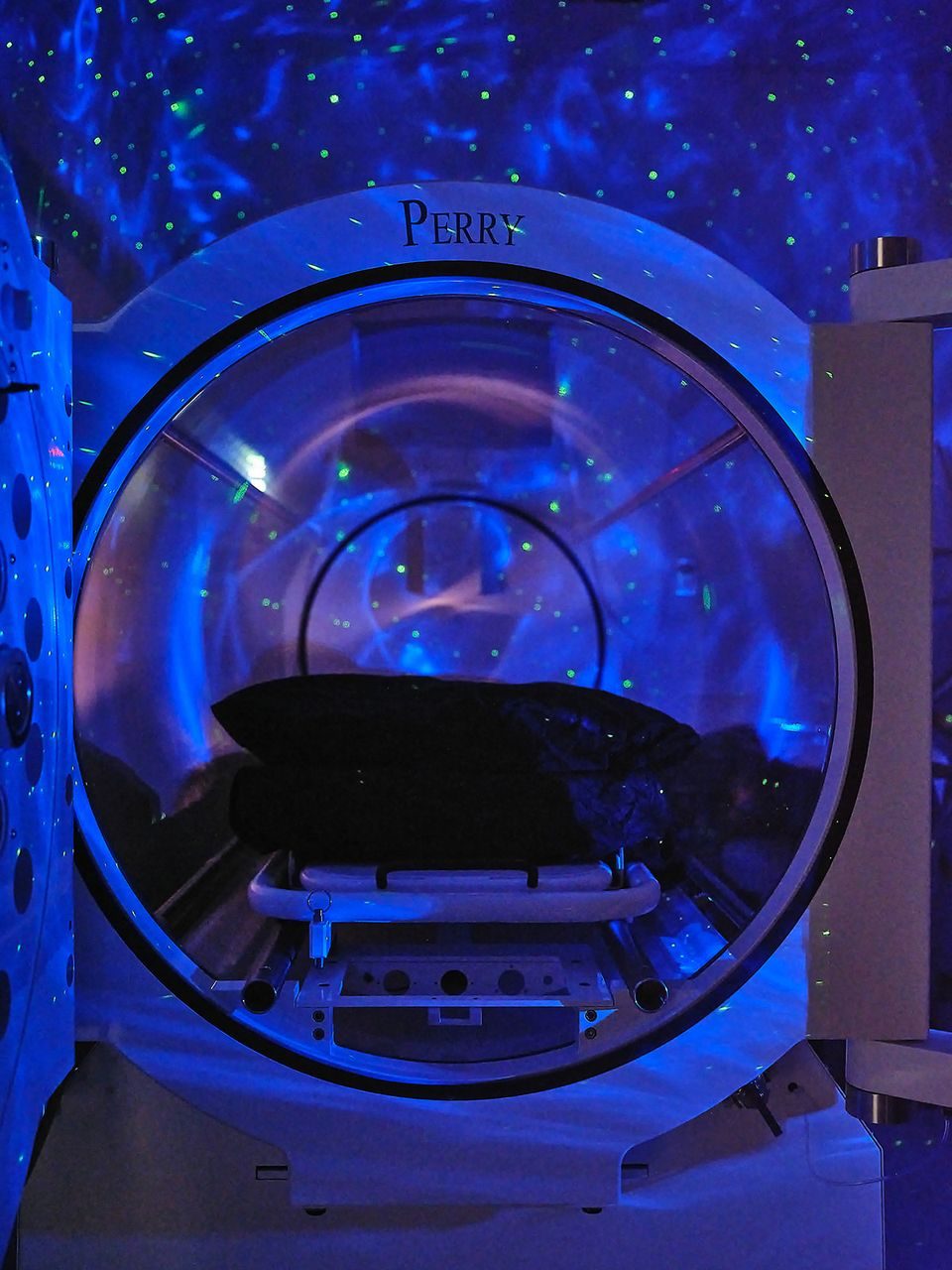
You settle into the chamber — ours is spacious, lit, and comfortable enough to read, nap, or watch a show. As pressure increases over several minutes you will feel your ears fill, exactly like an airplane descent; swallowing or yawning clears it. Then you simply breathe. Sessions run 60 to 90 minutes. There is no pain, no needles, and no downtime. Most people leave feeling calm and lightly energized, and a surprising number tell us it was the best nap of their month.
Results compound. A single session helps acute swelling; a series of 10 to 40 sessions is where angiogenesis and stem cell mobilization change the trajectory of chronic issues. We build a schedule around your goal, not a one-size package.
Oxygen Therapy as Part of a Protocol
HBOT rarely works alone at Zen. We pair it with NAD+ and vitamin IVs so your mitochondria have both the oxygen and the cofactors to produce energy, with peptides like BPC-157 to direct healing to the right tissue, and with compression therapy to move the resulting metabolic waste out of the system. Oxygen is the foundation; the rest of the stack builds on it.
If you are recovering from something, preparing for something, or simply tired of feeling slower than you used to, come sit in the chamber. The first session is the easiest way to understand what more oxygen feels like.