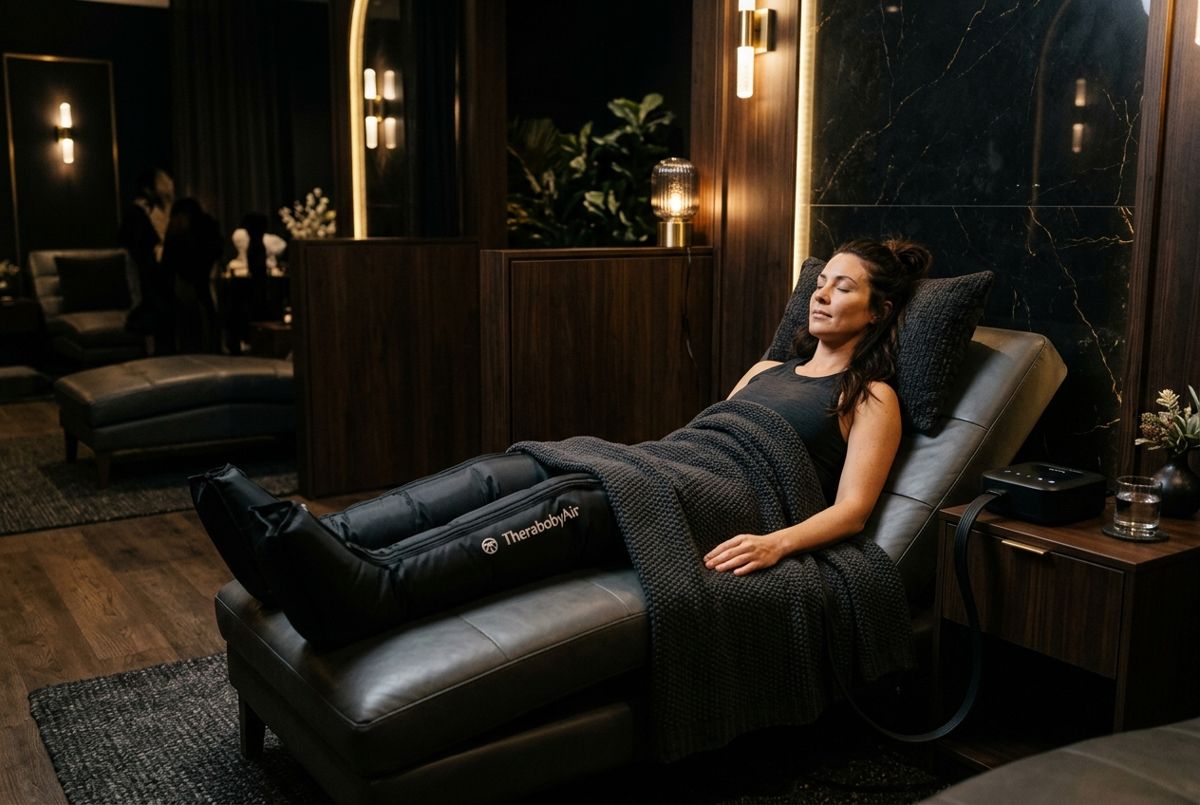

If you have ever watched a professional athlete on the sidelines zipped into inflating boots up to their hips, you have seen compression therapy. It looks a little like science fiction. In practice, it is one of the simplest and most effective recovery tools in medicine — a mechanical assist for a system your body already has but that runs slowly: your lymphatic and venous return.
What Compression Therapy Is
Dynamic (or pneumatic) compression therapy uses sleeves — most commonly for the legs, but also arms and hips — that inflate in sequential chambers from the furthest point toward the heart. The pattern mimics the natural muscle pump of walking or running, squeezing fluid upward in a controlled wave. Each cycle lasts a minute or two, and a session runs 20 to 45 minutes.
Unlike a static compression sock, which simply limits swelling, sequential pneumatic compression actively moves fluid. That is the difference between a dam and a pump.
Why Fluid Movement Is the Whole Game
Your arteries have the heart pushing blood out to tissue. Your veins and lymphatic vessels have no such pump — they rely on muscle contraction, breathing, and one-way valves to return fluid. When you sit, fly, stand all day, train hard, or recover from a procedure, that return slows. Metabolic byproducts, inflammatory proteins, and excess interstitial fluid pool in the tissue. That is the heaviness, swelling, soreness, and stiffness you feel.
- Accelerates clearance of lactate and inflammatory metabolites after training
- Reduces swelling and edema after surgery, travel, or long days on your feet
- Improves venous return and circulation to the extremities
- Decreases delayed-onset muscle soreness (DOMS) and shortens time-to-recovery
- Supports lymphatic drainage — the body's waste-removal and immune highway
- Promotes deep relaxation; the rhythmic pressure reliably lowers perceived stress
Who Benefits
Athletes and Weekend Warriors
Research across endurance and strength athletes consistently shows reduced soreness and faster return of power output in the 24–48 hours after compression sessions compared to passive rest. If you train hard more than three days a week, compression is the cheapest performance gain available.
Post-Procedure Patients
Swelling is the slowest part of almost every recovery. Our Zen Recovery patients use compression alongside hyperbaric oxygen to resolve post-surgical edema faster and lower the risk of fluid-related complications.
Frequent Travelers and Desk Professionals
Long flights and long meetings share a problem — hours without the leg muscle pump. Compression after travel reduces the heavy-leg feeling, helps reset circulation, and pairs beautifully with a hydration IV.
Anyone Carrying Inflammation
Lymphatic stagnation shows up as puffiness, stiffness, and slower healing. Regular compression keeps that system moving.
What a Session Feels Like
You recline, the sleeves go on over your clothes, and the chambers begin to inflate in sequence from your feet up. The pressure is firm but never painful — we tune intensity to you. Most people describe it as a deep, rhythmic massage. Many fall asleep. You walk out lighter, literally and figuratively, with no downtime.
Stacking Compression With Oxygen and IV Therapy
This is where our recovery protocols become more than the sum of their parts. Hyperbaric oxygen pushes oxygen into tissue and kicks off repair; compression then moves the metabolic waste that repair produces out through the lymphatic system; an IV restores the fluid, electrolytes, and nutrients the whole process consumed. Oxygen in, waste out, fuel replaced. Done in sequence, a two-hour visit can accomplish what passive rest takes days to do.
Compression therapy is not flashy. It is simply effective, and it is one of the first things we recommend to anyone who wants to recover like a professional.